
Human Rights
The Group adheres to and recognizes internationally accepted human rights standards, including the “International Bill of Human Rights,” the “International Labor Organization Declaration of Fundamental Principles and Rights at Work,” and the “Ten Principles of the United Nations Global Compact.” The Group has established a “Human Rights Policy” approved by the Chairman and takes actions consistent with the “RBA Code of Conduct,” treating all workers in its operations with dignity and respect.
The Sustainability and Risk Management Committee serves as the Group’s highest internal body for human rights management, while the HR Department regularly conducts human rights due diligence and ongoing human rights monitoring. The Group’s Human Rights Policy explicitly prohibits child labor and forced labor, eliminates unlawful discrimination, and ensures equal employment opportunities. It is also committed to creating a workplace that encourages open communication among employees and provides a safe and healthy working environment. We are committed to eliminating all forms of unlawful discrimination based on personal attributes, including gender, sexual orientation, race, nationality, religion, political affiliation, age, marital status, socioeconomic status, family status, disability, and appearance. The Group ensures equal rights for employees and guarantees decent work for all. All employees are required to complete human rights-related training annually. In 2025, the total human rights training hours reached 7,944 hours, with a 100% completion rate.
Internal Human Rights Risk Assessment
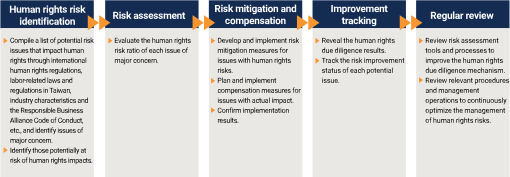
In order to implement the “Human Rights Policy”, the Company has established a human rights due diligence process. Every year, by reviewing relevant information on domestic and foreign human rights issues, relevant labor laws and regulations in Taiwan, industry characteristics and the Responsible Business Alliance Code of Conduct, the Company identifies potential human rights risk issues, differentiates affected objects and risk sources, and reviews the corresponding management through the results of risk assessment, so as to formulate or adjust risk mitigation measures to improve and follow-up on relevant measures, facilitating the effective control and the reduction of the human rights risk impacts and the achievement of management goals.
This year, our company assessed the human rights conditions at four of our locations in Taiwan: our Miaoli headquarters, Hsinchu office, Taipei office, and Tainan office. Because our business is simple and our core operations do not differ across locations, the mitigation plans we developed apply to all four locations./
Internal Human Rights Management Practices and Performance
The Group has established the “Regulations Governing Internal and External Communication and Complaint and Report Management,” which apply to all employees of the Group as well as external personnel who have business dealings with or maintain any stakeholder relationship with the Group. If any of the above personnel experience or become aware of any unlawful infringement, discrimination, improper disciplinary action, violations of integrity and ethical conduct, privacy breaches, or intellectual property violations, they may submit complaints through existing identified channels or the “Anonymous Feedback Box.” All complaints are immediately reported to the designated management representative of the Sustainability and Risk Management Committee, followed by an investigation. All cases may only be closed upon approval by the management representative. In 2025, the Group received a total of 25 submissions through the Anonymous Feedback Box, all of which were fully addressed and forwarded to the responsible departments for follow-up improvements and management adjustments.
In 2025, the Group achieved a 100% compliance rate in internal RBA human rights audits. The audit results have been submitted by auditors to the Sustainability and Risk Management Committee, enabling management to understand the implementation status of the human rights policy and related performance. In the future, the Group will continue to target a 100% compliance rate in the new annual cycle.
In addition to establishing a zero-tolerance policy against unlawful infringement, the Group also conducts annual internal and external training on the prevention of stalking and unlawful workplace harassment. All new hires and existing employees are required to complete the training, achieving a 100% training coverage rate. Given the prevalence of unlawful workplace harassment in contexts of power imbalance, Phison has additionally established a “Program on Illegal Infringement for Supervisors.” The Group continuously invites supervisors to participate in training on “Workplace Unlawful Infringement Prevention,” covering definitions, awareness, common cases, and preventive principles. It also integrates the “Employee Issue Identification” course to explain supervisors’ roles, responsibilities, and obligations, indicators for identifying employee anomalies, internal referral and support systems, and the EAPs. Over the past three years, the participation rate of supervisors in the “Program on Illegal Infringement for Supervisors” has reached 92%.
In addition, the Group distributes unlawful workplace harassment survey questionnaires to employees after annual health examinations, aiming to identify risks early and support employees in coping with potential issues. In 2025, a total of 3,718 questionnaires were distributed and valid responses collected. Based on follow-up analysis, 0.1% of employees reported perceiving potential external harassment risks, while 0.86% reported perceived internal harassment risks. The types of harassment identified were mainly verbal and psychological abuse. Medical staff first inform employees of both internal and external available resources, and explain that the Company has established management procedures and complaint mechanisms for unlawful workplace harassment. If a formal complaint is submitted, it will be officially accepted and handled in accordance with the procedures.
Living Wage
Decent work is closely linked to wage levels. To ensure that employees’ remuneration is sufficient to meet basic living needs with dignity, the Group adopts the concept of a “living wage” rather than a “minimum wage” to regularly review whether labor compensation meets local basic living requirements. Through the implementation of living wage principles, the Group aims to foster better labor-management relations and enhance the stability of business operations.
By referring to the Taiwan’s cost of living benchmark data published by Numbeo, the world’s largest cost of living database, in December 2025, Phison estimated that the expected monthly expenses for a single individual in Taiwan amounted to NT$24,997 (excluding rent). In addition, according to the nationwide rental survey results announced by the Ministry of the Interior for September 2025, the median monthly rent nationwide was NT$9,008. Based on these figures, it can be roughly estimated that employees renting housing would require a monthly salary of at least NT$34,005 to meet the requirements for a decent standard of living. According to the review results, the wages of all full-time employees of Phison currently exceed the aforementioned amount. The Company will continue to monitor salary levels in the future to ensure the implementation of living wage standards.
Note: Living wage refers to the wage level required to provide workers and their families with a decent standard of living, and only includes income earned within legally recognized working hours.
Violation of labor laws in the past three years:
Year | 2023 | 2024 | 2025 |
|---|---|---|---|
Number of breaches | 2 | 0 | 0 |
Disclosure of incidents of human rights violations in the past three years:
Year | 2023 | 2024 | 2025 |
|---|---|---|---|
Number of breaches | 0 | 1 | 1 |
