
Climate Change and Energy Management
The Group supports the carbon reduction goals of the Paris Agreement. In response to climate change and to promote green operations, the Group conducts greenhouse gas inventories on a regular annual basis and obtains verification in accordance with ISO 14064-1:2018.
In addition, the Group conducts annual environmental protection training as part of its regular refresher training for all employees. The training covers three core areas: waste reduction, water resource management, and energy management. By encouraging employees to develop a sustainability mindset centered on energy conservation, water conservation, and waste reduction, and by sharing specific and practical action plans, the Group aims to deepen employees’ understanding of the risks and impacts associated with climate change. We encourage employees to extend sustainable thinking into their daily lives by comprehensively identifying and reducing the waste of energy and resources, implementing plastic reduction and waste reduction at the source, and working together to create positive environmental impacts toward net-zero goals and reduce the burden on the planet.
Greenhouse Gas Management
Each year, in accordance with the ISO 14064-1:2018 GHG inventory standard, the Group adopts the operational control approach to define organizational boundaries, and evaluates the materiality of emission sources based on factors such as the availability of activity data, the availability of emission factors, and carbon reduction opportunities. These criteria are used to determine whether Categories 3 to 6 are included in the inventory, and the inventory is verified by an external third party. Since 2021, the Company has conducted annual GHG inventories, with 2025 selected as the base year for the GHG inventory, and regularly evaluates and manages the organization’s GHG emissions.
The organizational boundary for the current year includes the Zhunan Plant, Banqiao Office, Zhubei Office, Tainan Office, and Xiangshan Plant. The reporting boundary covers Category 1 (fixed emission sources, process emission sources, mobile emission sources, fugitive emission sources, etc.), Category 2 (purchased electricity), Category 3 (upstream and downstream transportation and distribution, employee commuting, business travel, etc.), Category 4 (purchased goods and services, waste disposal, etc.), and Category 5 (leased assets). Major potential GHG emission sources within the reporting boundary were identified. The types of GHG included carbon dioxide (CO2), methane (CH4), nitrous oxide (N2O), hydrofluorocarbons (HFCs), and sulfur hexafluoride (SF6), totaling five types of GHG.
The Group adopts the emission factor method for calculation, multiplying activity data by emission factors and global warming potential (GWP) values to convert emissions into carbon dioxide equivalent (CO2e), expressed in metric tons of carbon dioxide equivalent (tCO2e). The emission factors were sourced from the latest “GHG Emission Factors” announced by the Ministry of Environment of the Executive Yuan. GWP values adopted those published by the IPCC (IPCC Sixth Assessment Report). The electricity emission factor adopted the 2024 electricity emission factor published by the Energy Administration of the Ministry of Economic Affairs in Taiwan. Other emission factors referenced sources including the Ministry of Environment Product Carbon Footprint Information Platform, the “GHG Emission Factors” announced by the Ministry of Environment on February 5, 2024, the China Airlines carbon footprint calculation system, the High Speed Rail transportation service carbon footprint, the Taipei Metro passenger transportation service carbon footprint, product carbon factors provided by suppliers, and the Ecoinvent 3.11 database.
In 2025, the Group’s total GHG emissions amounted to 195,314.497 tCO2e, of which Category 1 emissions were 340.6776 tCO2e (0.2%), Category 2 (market-based) emissions were 19,575.7209 tCO2e (10%), and Category 3-6 emissions were 175,398.0989 tCO2e (89.8%). Using total revenue (in NT$ millions) as the intensity denominator, the emission intensity (Category 1 + Category 2) was 0.274 (tCO2e/NT$ million).
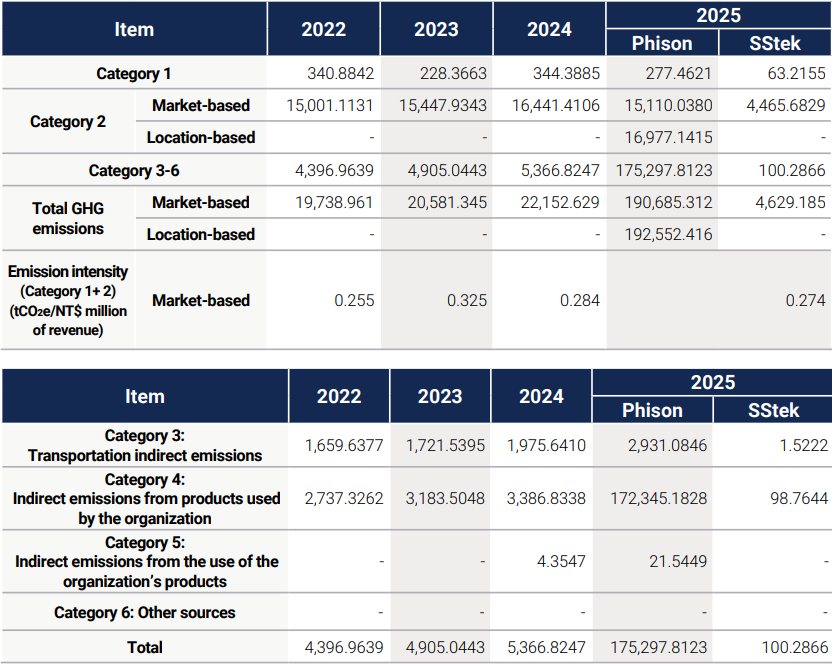
Note 1: As the organizational carbon inventory of SStek has not yet obtained external verification, the data is temporarily disclosed separately from that of the parent company.
Note 2: Due to structural changes in the Company’s reporting boundary in 2025, including the inclusion of process emissions, purchased raw material usage, and changes in the quantification methods for upstream/downstream transportation and employee commuting, recalculations were conducted in accordance with the base year recalculation mechanism. However, because relevant data for the base year was unavailable and retrospective adjustment could not be performed, 2025 was adopted as the GHG inventory base year to ensure the reliability of the inventory data.
Statistics of Energy Consumption
The Group’s headquarters office buildings are progressively introducing ISO 50001. Through the energy management system, real-time electricity consumption is monitored using big data analytics to identify abnormal energy usage and implement optimization measures. The Group’s energy consumption is primarily dominated by purchased electricity from non-renewable sources, accounting for approximately 91.13% of total energy consumption. The remaining energy sources consist of purchased electricity from renewable sources at 8.69% and fossil fuels at 0.17%. Therefore, future energy-saving plans will primarily focus on purchased electricity as the main target for energy reduction.
In 2025, due to the first-time inclusion of SStek in the disclosure scope, the Group’s overall energy consumption increased by 34,497 GJ compared to the previous year, and energy intensity rose from 2.183 to 2.246. However, if only Phison Electronics’ operating sites are considered, energy consumption in 2025 increased by only 573 GJ compared to 2024. Taking into account business growth, this actually demonstrates the effectiveness of energy-saving initiatives.
The Group began purchasing renewable energy (bundled electricity and certificates) in 2021 and has set the target for the parent company of the Phison to achieve 10% renewable energy usage by 2025 and 20% by 2030. Looking solely at Phison Electronics, renewable energy usage has continued to increase through nearly doubling annual procurement volumes each year. In 2025, renewable energy consumption accounted for 11% of total electricity consumption, achieving the renewable energy usage commitment for 2025, and the Group will continue progressing toward the 20% target, evaluate various renewable energy procurement options and steadily advance its energy transition, thereby reducing GHG emissions generated during its operations. In the current year, the Group obtained a total of 3,946 RECs.
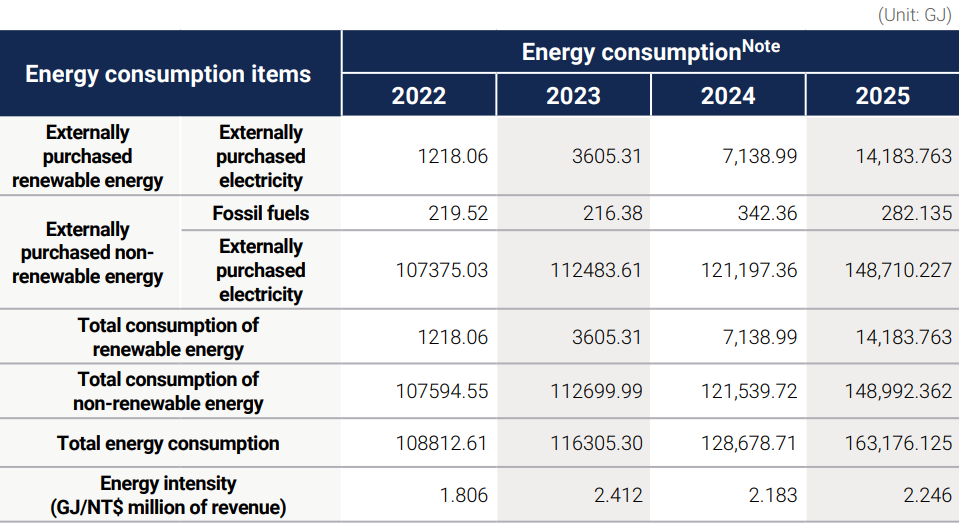
Note 1: Heating values are based on the latest energy unit heating value table published on the website of the Energy Administration, Ministry of Economic Affairs. Energy consumption is calculated by multiplying energy usage by the unit heating value and converting the result into gigajoules (GJ).
Note 2: 1 kilocalorie (Kcal) = 4,187 joules; the heat value coefficient of 1 kilowatt-hour (kWh) is 860 Kcal; the heat value coefficient of diesel per liter (L) is 8,629 Kcal; and the heat value coefficient of automotive gasoline per liter (L) is 7,520 Kcal.
Climate risk scenario simulation
The company conducts scenario simulations for rainfall under different warming scenarios, analyzes the risk and threats, and formulates emergency response plans for relevant departments to follow.
Warming Scenario | Rainfall Scenario | Risk | Emergency Response Plan |
|---|---|---|---|
SSP1-2.6 | Intense plum rain season for one week, with heavy rainfall levels (over 350mm /24h or over 200mm /3h) in Miaoli area | 1. Flooding in low-lying areas | 1. Ensure regular inspections of all drainage ditches to maintain unobstructed flow. 2. Follow the disaster accident classification and response execution of the QP2107 Emergency Response Management Process, with the factory affairs dept. and EHS dept. monitoring the heavy rainfall alerts issued by the Central Weather Bureau. 3. When heavy rainfall levels (over 350mm /24h or over 200mm /3h) are announced, internal company emails will be sent to alert employees to pay attention to road conditions, close windows and doors, and notify the factory department to prepare for disaster prevention, placing sandbags at all entrances and exits. |
SSP5-8.5 | Intense typhoon (central wind speed over 51 meters per second) affecting Taiwan, with extremely heavy rainfall levels (over 500mm/24h) in Miaoli area | 1. Road flooding 2. Road closures 3. Power outages | 1. Ensure regular inspections of all drainage ditches to maintain unobstructed flow. 2. Follow the disaster accident classification and response execution of the QP2107 Emergency Response Management Process, with the factory and environmental safety departments monitoring the typhoon alerts issued by the Central Weather Bureau. 3. When the Central Weather Bureau issues a maritime typhoon warning, the factory affairs dept. immediately executes typhoon prevention measures, confirms the fuel levels of emergency generators, places sandbags at all entrances and exits, and conducts detailed inspections of the factory (server rooms) to prevent the disaster from spreading inside. 4. When the Central Weather Bureau issues a land typhoon warning, conduct another inspection of all entrances and exits and the factory (server rooms), and continuously track the typhoon updates issued by the Central Weather Bureau. 5. When the Miaoli County Government announces a suspension of work and classes, block the entrance to the underground parking lot, notify all departments to count the number of employees currently in the factory, and confirm the safety of all employees. 6. If a power outage occurs, the factory affairs dept. immediately activates the emergency generator to provide power and inquires with Taipower about the cause of the power outage and the estimated time for power restoration. |
