
Supply Chain Management
The Company sees suppliers as our important partners. We are committed to building mutual trust and a stable sustainable supply chain, as well as flourishing businesses together with our suppliers. The Company assesses suppliers against the criteria, namely Quality, Cost, Delivery, Service, and Sustainable Risks, by using our business influence to demand that they disclose sustainability information and improve their sustainability performance.
Four Major Principles of Supply Chain Management
New suppliers of the Company are required to meet basic corporate social responsibility assessments, covering human rights, occupational health and safety, and environmental management. Business cooperation with the Company may only commence after passing the assessment. Subsequently, suppliers meeting the transaction criteria are also required to complete the “Supplier/Contractor Sustainability Risk Assessment Questionnaire.” Therefore, the percentage of new suppliers screened using environmental standards and social criteria is 100%. At present, SStek only requires new suppliers to sign a Supplier Commitment Letter and has not yet applied social and environmental criteria for screening new suppliers.
The Group stipulates in procurement contracts with suppliers that they must comply with the RBA Code of Conduct. Each year, based on transaction criteria set by the Production Management and Procurement Departments, existing suppliers are required to complete the “Supplier/Contractor Sustainability Risk Assessment Questionnaire,” which covers five areas: labor, occupational health and safety, environmental protection, supply chain management, and corporate governance. The Group’s quality assurance personnel conduct a secondary review and classify suppliers’ sustainability risk levels based on their scores. Subsequent supply chain management and optimization are carried out based on suppliers’ long-term sustainability performance.
In 2025, a total of 76 suppliers were assessed for environmental and social impacts through the “Supplier/Contractor Sustainability Risk Assessment Questionnaire.” Among them, 2 suppliers were identified as having significant actual or potential negative impacts on the environment or society. The primary risks included incomplete policies, lack of environmental management plans, and absence of supplier management systems. Both suppliers have not yet committed to corrective actions (0% of suppliers agreed to improvements). The Procurement Department will continue to monitor the progress of non-compliant suppliers over the next two years. The percentage of supplier relationships terminated following assessment in the current year was 0%.
At the same time, the Group identifies key suppliers based on factors such as procurement amount, delivery frequency, and supply nature, in accordance with risk assessment results. Key suppliers are required to sign the “RBA Supplier Code of Conduct” (with a 100% signing rate) and to undergo an annual RBA audit conducted by the Group’s professional personnel. In addition, the Group emphasizes enhancing suppliers’ sustainability management capabilities. Through RBA audit briefings and training courses, suppliers are educated on topics including the prohibition of child labor, human rights, anti-discrimination/anti-harassment, health and safety, pollution and greenhouse gas management, anti-corruption, grievance mechanisms, privacy, management systems, material restrictions, and responsible mineral sourcing. These efforts aim to strengthen sustainability awareness across the entire supply chain. In 2025, a total of 25 suppliers participated in the annual supplier training program.
In addition, Employees in departments with procurement functions related to core business operations (Production Management and Procurement Departments) are required to complete the annual “Sustainable Supply Chain – Role Awareness and Capability Development Course.” The course covers topics including the definition and importance of sustainable supply chain management, the relationship between procurement behavior and the era of carbon pricing, product carbon footprint and organizational carbon emissions, and sustainable raw materials , with the aim of enhancing the sustainable supply chain management capabilities of relevant personnel.

Corresponding sustainability standards that suppliers at all levels should meet
Purchasing Department and Production Control Department should prepare and regularly check the “QR2303 Main Supplier List” every year. The inventory can be based on annual expenditure, key components of core business, multiple procurement, within the supply chain of the ICT (Information and Communication Technology) industry, etc.
Raw material suppliers are divided into A Level, B Level and C Level based on the total purchase amount and continuing transaction amount. Sub-contractors are classified into A Level and B Level based on production volume and whether they are customer designated processing factory. The sustainability standards that suppliers at all levels of the Purchasing Department and Production Management Department should meet are as follows:
Grading | Sustainable standards |
|---|---|
A level | Obtain ISO 14001 certificate |
Obtain ISO 14064-1 certificate | |
Obtain ISO 45001 certificate | |
Fill out the “QR0654-A Supplier/Subcontractor Sustainability Assessment Questionnaire” every year | |
B or C level | Fill out the “QR0654-A Supplier/Subcontractor Sustainability Assessment Questionnaire” every year |
Supplier Audit
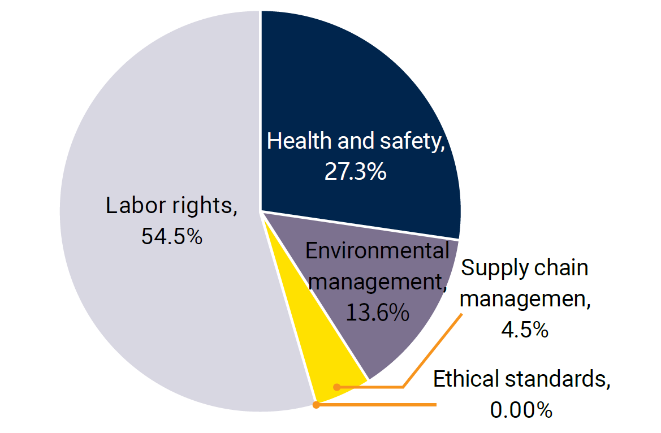
To reduce sustainability risks in the supply chain, the Group has established the “RBA Vendor Management Policy” and conducts annual audits on the compliance and effectiveness of Tier-1 key suppliers in areas including labor human rights, health and safety, environmental management, ethical standards, and supply chain management. During the current year, on-site audits were conducted for 18 Tier-1 key suppliers classified as high risk, while the remaining 15 key suppliers classified as medium risk underwent document reviews. If auditors identify deficiencies during the audit process, they will immediately communicate with the supplier. The findings are subsequently reported to department supervisors, and the supplier is required to propose an improvement plan. Suppliers must submit a corrective action plan within one week.
In 2025, the overall audit pass rate was 96.97%, with 22 non-conformity items identified. The majority of deficiencies were related to excessive overtime and health and safety issues. The Group’s audit representatives have shared audit findings with each supplier and discussed potential improvement measures. In accordance with the management procedures, the Group’s audit representatives may agree with suppliers on corrective action deadlines. If improvements are not completed within the agreed timeframe, the Group may implement measures such as reducing orders, suspending purchase orders, or revoking qualified supplier status.
Defect Analysis for Supplier Audit
Metal Raw Materials
The Company has calculated the metal usage and recycling ratio in 2025 for major suppliers in PCB, Connector and structural components. The results are as follows.
Item | Recycled material weight(t) | Total Amount(t) | Recycled proportion |
|---|---|---|---|
Aluminum (Al) | 4.15 | 658.84 | 0.63% |
Stainless steel | 0.00189 | 0.88 | 0.21% |
Copper (Cu) | 578.66 | 912.22 | 63.43% |
Nickel (Ni) | 0 | 2.30 | 0.00% |
Gold (Au) | 0.000048 | 0.39 | 0.01% |
Iron | 0 | 38.19 | 0.00% |
